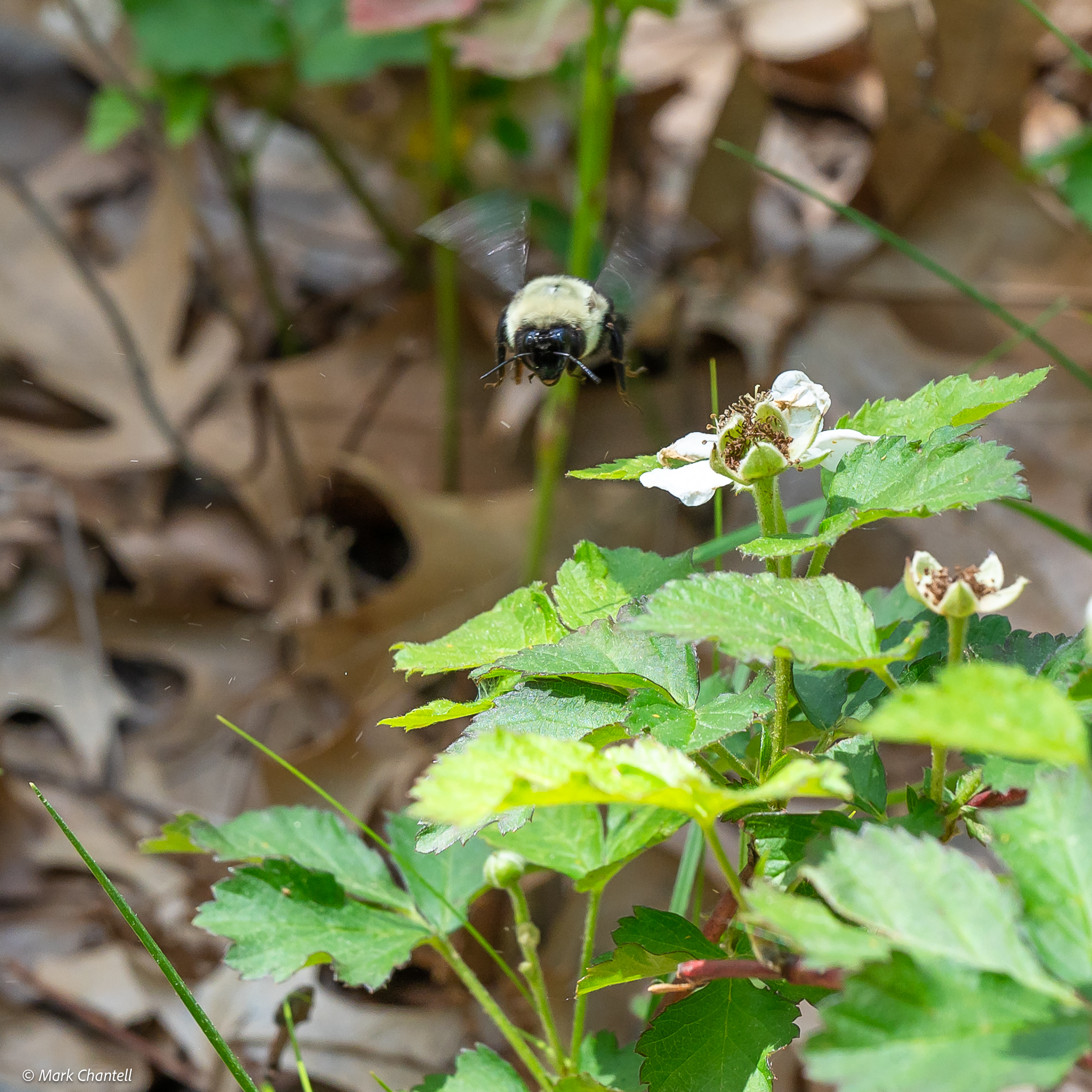
Look closely at the area down and to the left of the Bumblebee in the photograph above. You should be able to make out a number of tiny short lines. This is actually pollen that has been shaken free from the flower by vibrations from the wings of the Bumblebee. This is known as Buzz Pollination, in physics terms we would call it Sonication.
Certain plants store their pollen deep in the anther, inaccessible to most insects. In order to get the pollen Bumblebees will hover next to the flower and momentarily speed up the beating of their winds to about 300 beats per second. This causes the anther of the flower to vibrate and knocks the pollen loose. Interestingly honey Bees do not have this ability.
From taking photos of insects feeding on wild flowers and observing their behavior, I knew that Bumblebees will periodically take flight and hover around the flower they are interested in and then land again. A single Bumblebee might repeat this process several times for a given flower before moving on to another. Now I understand why they do this, which is super cool for me.
This is an example of how the photographs I take while hiking greatly enhance my appreciation for and understanding of nature. When I took the photo I was simply trying to capture the Bumblebee in flight. It was not until I was examining it at home that I noticed the tiny flecks of something near the insect. Curiosity led me to research what I was looking at. I learn something new about nature virtually every time I go out hiking, and my photography plays a big role in this learning.